TABLE OF CONTENTS
Section I ― Landscape
The Context of Risk in the Backcountry
Chapter 1: Environment – What Is It with People, Anyway?
- An exploration of why traditional snow science isn’t enough when human nature enters the equation.
Chapter 2: Culture – It Is a Grim Landscape . . . Or Is It?
- Unpacking the “Siren Song of Culture” and how social circles subtly distort our perception of danger.
Section II ― Judgement
The Cognitive Science of Human Error
Chapter 3: A Day in the Mountains
Chapter 4: Thinking . . . Fast and Slow
- Applying Daniel Kahneman’s Nobel Prize-winning System 1 and System 2 frameworks directly to split-second winter decisions.
Chapter 5: Intuition
- The critical difference between trained, reliable intuition and dangerous emotional guesswork.
Chapter 6: Bias & Heuristics
- Recognizing Ian McCammon’s heuristic traps that cause even veteran guides to look past obvious red flags.
Chapter 7: What You See Is All There Is (WYSIATI)
Chapter 8: Optimism & Luck
- Are we calculating true risk, or simply rolling the dice and mistaking good luck for good decision-making?
Section III ― Rules, Tools and Strategy
Practical Mitigation Frameworks
Chapter 9: Framing a Risk
Chapter 10: Teamwork
- How to structure group communication to combat dangerous heuristic traps and peer pressure.
Chapter 11: Mindset
- Transitioning to a strategic mindset that actively manages the unknown as much as the known.
Chapter 12: The Public Avalanche Bulletin
Chapter 13: The Avaluator & Rules of Thumb
- Using Gary Klein’s recognition-primed decision models to build practical, life-saving field boundaries.
Section IV: Concluding Thoughts
Final Metaphors & Moving Forward
Chapter 14: One Last Comparison
Chapter 15: One Last Metaphor
- A powerful look in the mirror to ensure your education in the mountains is never truly finished.
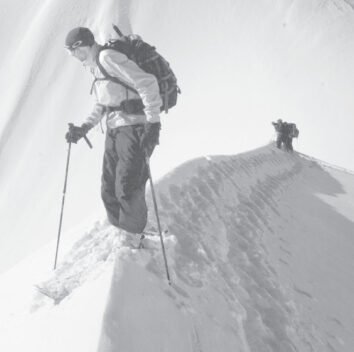
Photo by Jia Condon